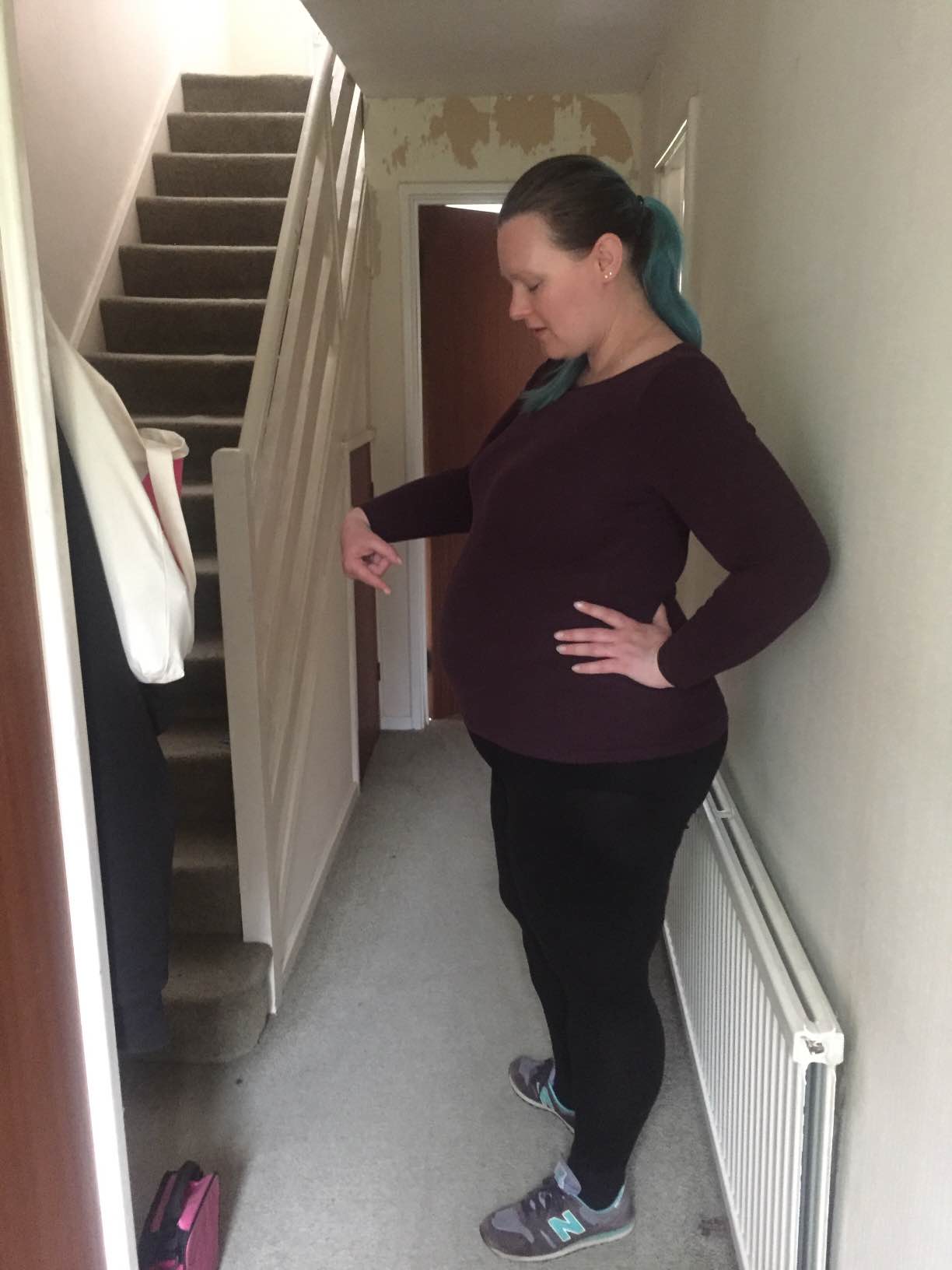
Author: Mama Bug

  • Into Week 38 – A Stick Of Rhubarb

    Into Week 38 – A Stick Of Rhubarb

    Your baby is about the length of a stick of rhubarb measuring 50cm (head to heel) and weighs just over 3kg…

    YOUR GROWING BABY

    The hands have fully formed nails that reach the end of the fingers and the grasp is strong. You will soon be able to feel this when your baby grabs your finger for the first time. The organs have matured and are ready for life outside the womb.

    The intestines are accumulating lots of meconium (baby’s first bowel movement). The circumference of the head and the baby’s abdomen are about the same size.

    If the eyes are grey or dark blue at birth, they may stay grey or blue or turn green, hazel, or brown as your baby gets older. This is because a child’s irises (the coloured part of the eye) may gain more pigment in the months after birth.

    WHAT’S HAPPENING TO YOU

    The next couple of weeks are a waiting game. Try not to be despondent if you are fed up with being pregnant. The end is almost in sight and your baby will soon be here.

    It’s important to keep an eye on any swelling in your feet and ankles and remember to elevate your legs as often as possible.

    Braxton Hicks contractions, unlike real contractions, don’t build up and are not painful, just uncomfortable. True contractions, however, start at the top of your uterus and then spread over the entire uterus, through your lower back and into the pelvis. True labour will become stronger and more painful and won’t be alleviated by changing position.

    NEED TO KNOW

    Things for you to consider during week 38 of your pregnancy:

    • Take naps, catch up on your reading, and spend uninterrupted time with your partner while you can.
    • Use this time to finish preparing your baby’s nursery or to do the tasks you may not get around to for a while after your baby’s born.
    • Make sure you have the emails and phone numbers of everyone you want to contact once the baby is born.
    • It’s a good idea to get measured for a nursing bra now.
    • Consider getting your hair cut into an easy-to-manage style. Time for yourself will be limited once the baby arrives.
    • Your midwife will check to see how the baby is lying at your antenatal checks

  • Into Week 37 – Small Watermelon

    Into Week 37 – Small Watermelon

    YOUR GROWING BABY

    If you go into labour at 37 weeks pregnant your baby’s lungs will most likely be mature enough to fully adjust to life outside the womb. However, if you are intending to have a Caesarean section and are carrying only one baby your doctor will not usually plan the operation until around week 39. This will ensure the maximum development of the baby’s lungs, brain and other organs before birth.

    Many babies have a full head of hair at birth which can measure up to an inch and a half in length, whereas others may come out with only a peach fuzz.

    Your baby’s body fat is now around 8% – this will increase to 15% in the next three weeks in time for birth.

    Antibodies continue to transfer through the placenta to improve your baby’s immune system and after the birth your breast milk will continue to supply these antibodies. Colostrum, your baby’s first milk, is rich in nutrients and antibodies and the breast milk that follows is nutritionally balanced and will help protect your baby from infections and build immunity.

    WHAT’S HAPPENING TO YOU

    It may be harder than ever to get comfortable enough to sleep well at night and you may also be experiencing intense dreams. Anxiety about both labour and becoming a parent can cause your subconscious to go into overdrive.

    Braxton Hicks contractions may last longer and feel more uncomfortable and you might also notice an increase in vaginal discharge.

    You may experience what is known as a ‘nesting instinct’. This is when you have a sudden burst of energy and start cleaning everything in sight. Try not to overdo it, even if you feel on top of the world. You need to conserve your energy for labour and birth.

    NEED TO KNOW

    Things for you to consider during week 37 of your pregnancy:

    • Keep monitoring your baby’s movements and let your midwife or doctor know immediately if you notice any decrease.
    • If you are planning to have your baby in a birth centre or maternity unit you will be given the opportunity to look round before you go into labour. Ask you midwife if this hasn’t happened.
    • Try to take it easy through the day, as this may be your last chance to do so for quite a while.
    • Make up some meals for the freezer (you will be busy once baby arrives).
  • Hey Little One…

    Hey Little One…

    …it’s been a while. Been providing you with regular updates with what’s going on each week with the both of us, but not really sharing what’s really happening.

    Your Dad and I were at the hospital again today for a quick scan to make sure you’re ok. You are doing awesome. We walked out of there happy, and so excited to meet you. We paid the hospital a visit last week as you weren’t moving as much as usual and we were concerned. Guess you were just chilling. You gave us quite a scare. I was hooked up to an ECG machine to monitor your heartbeat and mine. You weren’t keen on the monitors on you, you kicked and kicked until it was taken off. Ha ha! Make your Dad and I laugh.

    Your Dad and I go to a car show every year with friends called Modified Nationals. We drive up Friday night, the show is Saturday and Sunday, and we come home after the show on Sunday afternoon. We had a great time but I think you and I were really tuckered out. With the heat and everything else, my hands really swelled up, to the point that I had to removed my engagement ring, which I almost couldn’t. Scary! On the plus side, we bought two gorgeous dresses, one of which you might be wearing on your Mum and Dad’s wedding day in a couple months.

    Our wedding rings that we ordered were ready to collect on Monday just gone, but my hands were still too swollen to try them on properly. Ha ha! Still looks beautiful though. VERY much looking forward to your Dad putting that on my finger our wedding day. We still can’t believe you will actually be there! Crazy!

    A couple of my friends were kind enough to throw us a baby shower, and they were so unbelievably generous. Your Dad and I were blown away by amount of awesome gifts we received for you. Pretty clothes, useful gadgets and loads of nappies and other bits.

    You are getting so big and strong. Your heartbeat and kicks are stronger than ever. Just a few weeks and we will get to meet you, and your Dad and I cant wait.

  • Into Week 36 – Honeydew Melon

    Into Week 36 – Honeydew Melon

    Your baby is the size of a head of romaine lettuce 2.7kg and measures 48cm (head to heel)…

    YOUR GROWING BABY

    At this stage you are likely to feel jabs from the elbows and feet and complete body rolls as your baby changes position.

    The downy hair that has been covering your baby’s skin until now is being shed and the waxy vernix, which has protected the skin, is also disappearing. These substances are swallowed by your baby in the amniotic fluid and result in the dark first bowel movement after birth called meconium.

    After this week your baby will be considered term and should be waiting in the head-down birth position.

    Only 3-4% of babies are in a breech position at term and your midwife will discuss the risks and benefits of turning the baby and the best way for it to be born.

    WHAT’S HAPPENING TO YOU

    Small more frequent meals may be easier to manage as your stomach is being squashed by your growing baby. Hopefully, the heartburn has eased and your breathing is easier now that the baby has moved down into your pelvis.

    If baby is engaged you may feel extra pressure in the pelvic area. This could cause discomfort and walking might be uncomfortable for you.

    Braxton Hicks contractions are more frequent now in preparation for the real thing.

    At 36 weeks pregnant these last few weeks should be a straightforward waiting game, but if you experience any vaginal bleeding or if you think that the amniotic fluid is leaking you must seek medical help. Other warning signs to be aware of include constant abdominal pain, persistent or severe headache and blurred vision.

    NEED TO KNOW

    Things for you to consider during week 36 of your pregnancy:

    • Contact your healthcare professional if you experience any of the symptoms mentioned above.
    • If you have any reason to be concerned about a reduction in your baby’s movements you should contact your midwife or healthcare professional immediately.
    • Antenatal checks are often weekly from now on until you give birth.
    • It’s perfectly normal to be having vivid dreams now.
    • If your baby’s head becomes ‘engaged’ this week – this means dropping down into the pelvis ready for birth – you will notice that your bump has moved lower down.
  • Into Week 35 – Honeydew Melon

    Into Week 35 – Honeydew Melon

    Your baby is the size of a honeydew melon 2.4kg and measures 47cm (head to heel)…

    YOUR GROWING BABY

    Your baby now has less room to manoeuvre around so somersaults may be a thing of the past. Kicking, however, remains very common! Keep a check on your baby’s movements – a change or loss of movement could indicate a problem, which should never be ignored as it could mean your baby is in distress.

    The nervous and immune systems are still finishing off their development but everything else is fully formed from the hair on the head to the tiny toenails. The kidneys are fully functional and the liver is now processing some waste products.

    The next few weeks are mainly about your baby putting on weight.

    WHAT’S HAPPENING TO YOU

    Your uterus is crowding your internal organs and this explains why you need to visit the loo so frequently. Your womb expands upwards under the ribcage causing heartburn or gastric discomfort for most women.

    If Group B streptococcus (GBS) is detected during pregnancy in a vaginal swab or in your urine, intravenous antibiotics may be offered to you during labour to prevent the bacteria being passed on to your baby. Your midwife or GP will be able to give you more information.

    The pregnancy hormone relaxin, coupled with the weight of your baby, causes your pelvic joints to expand in readiness for the birth. You are likely to be experiencing pregnancy related aches and pains in this area.

    NEED TO KNOW

    Things for you to consider during week 35 of your pregnancy:

    • You may want to discuss your birth preferences now with your partner and midwife.
    • If you need more information about how the birth will work in the place you have chosen to have your baby (home/birth centre/hospital) speak to your midwife.
    • Bags should be packed for labour and for after the birth. Even if you are having a home birth it’s a good idea to have everything you want in one place.
    • The measurement in centimetres from the top of your pubic bone to the top of your uterus is roughly equivalent to the number of weeks of pregnancy.
    • Keep practising your pelvic floor exercises.
    • Talk to your midwife about pain relief options. Even if you plan to have a drug-free birth it’s good to know what your choices are in case you change your mind.
    • If your breasts have started leaking, place breast pads inside your bra to mop up any further leaks.
  • Into Week 34 – Cantaloupe Melon

    Into Week 34 – Cantaloupe Melon

    Your baby is the size of a cantaloupe melon 2.1kg and measures 44.5cm (head to heel)…

    YOUR GROWING BABY

    The brain is working enthusiastically forming all of the millions of complex connections needed for learning in the outside world. While this is happening your baby may be sleeping much more and possibly even dreaming. This can be monitored by the rapid eye movement (REM) during sleep.

    Your baby’s brain is not the finished article at birth and will triple in size in the first year. At the age of one your baby’s brain is three-quarters the size of that of an adult.

    The lungs are maturing well and healthy babies born now are at less risk of needing extra help with their breathing, but may still need extra care after birth and require monitoring in the neonatal nursery.

    WHAT’S HAPPENING TO YOU

    By this week, fatigue has probably set in again and your tiredness is perfectly understandable. Now is the time to take frequent rests and conserve your energy for the big day.

    Your vision may seem blurry and a decrease in tear production can leave your eyes dry and irritated. An increase in fluid in the eye can change their shape so you may find you are more near-sighted or far-sighted than usual. These changes are temporary and your eyes will return to normal after you’ve had your baby.

    Gestational diabetes is a form of diabetes that occurs only in pregnancy when the body can’t make or use enough insulin to meet the extra demands of pregnancy. Gestational diabetes can be controlled by keeping physically active and making healthy changes to the diet such as cutting down on sugary foods and replacing them with starchy foods like pasta and rice and eating at least five portions of fruit and vegetables a day. But, for one in five women, medication and/or insulin injections are required during the rest of the pregnancy.

    NEED TO KNOW

    Things for you to consider during week 34 of your pregnancy:

    • See your midwife every two weeks from now on to assess your wellbeing.
    • Contact your midwife/maternity unit immediately if you experience any vaginal bleeding.
    • If you wear contact lenses you may find glasses more comfortable these days.
    • If you have gestational diabetes you have a two-in-three chance of developing gestational diabetes in a future pregnancy. You are also at higher risk of developing diabetes later in life so you should have an annual blood check which you GP can arrange.
  • Into Week 33 – Pineapple

    Into Week 33 – Pineapple

    Your baby now weighs about the same as a pineapple 1.9kg and measures 43.7cm (head to heel)…

    YOUR GROWING BABY

    Your baby is gaining is about 220g (8 oz) a week and the skinny, wrinkled look is becoming a thing of the past.

    Your baby’s skeleton is continuing to harden but the bones in the skull will not fuse together. This is to allow them to move and slightly overlap whilst travelling through the birth canal. (The pressure during birth is so intense that many babies are born with a cone-shaped head). These bones don’t entirely fuse until around two years of age.

    Your baby has probably moved into the birth position with the head downwards and may descend further into your pelvis at any time within the next six weeks.

    During the last 12 weeks of pregnancy, antibodies, which help fight infection, are passed from you into your baby through the placenta. Babies born prematurely are at greater risk of infection, as they have not had the same transfer of antibodies to them in the last weeks of pregnancy.

    WHAT’S HAPPENING TO YOU

    As your baby fills out it may become more and more difficult to find an easy position to sit and sleep in. You may also be doing rather a lot of waddling and bumping into things.

    If your hands and fingers swell, pressure may be put on the carpal tunnel that houses the tendons and nerves that run to the fingers.

    This can result in pins and needles and numbness in your fingers and may cause pain to radiate from the wrist to the forearm. In severe cases you may need to see a physiotherapist who may suggest that you wear splints on the wrists at night.

    NEED TO KNOW

    Things for you to consider during week 33 of your pregnancy:

    • Try sleeping with your hands raised on a pillow to prevent fluid from building up.
    • Take frequent breaks if you work at a keyboard so that you can flex the fingers and rotate the wrists to exercise them.
    • Make sure you include omega-3 fatty acids (DHA) in your diet. Found mainly in oily fish such as salmon and mackerel, DHA is crucial for your baby’s brain and vision development. Up to a maximum of two portions of oily fish per week is recommended in pregnancy.
    • If you are finding it hard to sleep at night, develop a winding-down routine before bedtime. Try a candle-lit bath with some lavender oil added to make you sleepy, listen to relaxing music and have a milky drink before you go to bed.
  • Into Week 32 – Chinese Cabbage

    Into Week 32 – Chinese Cabbage

    Your baby now weighs the same as a Chinese cabbage 1.7kg and measures 42.4cm (head to heel)…

    YOUR GROWING BABY

    You’re gaining about 450g (1lb) a week and roughly half of that goes straight to your baby. During the next seven weeks your baby will gain between a third and a half of birth weight whilst fattening up for survival outside the womb.

    Your baby is practising all the skills needed to survive outside the womb, from swallowing and breathing to sucking and kicking. The digestive system is fully functioning. Toenails, fingernails, and real hair have formed and the skin is becoming soft and smooth.

    Your baby’s movements may change as the amount of space inside the uterus decreases. But there should still be a regular pattern of movement. If you notice any change, or lessening of your baby’s movements you should go straight to the maternity unit, as this could be a sign your baby is in trouble.

    WHAT’S HAPPENING TO YOU

    To accommodate your baby’s growing needs, your blood volume has increased 40 to 50 percent since you became pregnant.

    Your uterus is pushing up near your diaphragm and crowding your stomach increasing the likelihood of shortness of breath and heartburn.

    Braxton Hicks contractions are likely to be more noticeable now and will continue to increase in both frequency and strength until real labour begins. You will feel a painless, tightening sensation, starting at the top of the uterus and spreading downwards, which can last anything from15 seconds up to two minutes. They are irregular and will stop if you change position.

    NEED TO KNOW

    Things for you to consider during week 32 of your pregnancy:

    To help relieve any discomfort caused by shortness of breath and heartburn, try sleeping propped up with pillows and eating smaller, more frequent meals.

    Practise some deep breathing or relaxation techniques in preparation for labour and birth.

    If you haven’t already made a birth plan, think about doing one now. It will help you decide how you would like your labour and birth to be managed.

    Delivery of larger items of baby equipment, such as a pram or car seat, can take a number of weeks so if you haven’t placed an order yet, you should do it now. Check that the items can be delivered in time for your baby’s arrival.

    Practise putting the car seat into the car so that you know how it works before the baby arrives.

  • Into Week 31 – Coconut

    Into Week 31 – Coconut

    Your baby is now the weight of a coconut 1.5kg and measures 41.1cm (head to heel)…

    Your growing baby

    Your baby’s body is entering another growth spurt as much needed fat accumulates under the skin. The constant bouts of activity are an excellent sign of a healthy baby, but these somersaults and kicks may be keeping you awake at night.

    The eyes continue to develop and the pupils can now dilate in reaction to the light that filters in through the wall of the uterus. The eyelids are likely to be open during the time your baby is awake and closed when its asleep.

    What’s happening to you

    You may be experiencing Braxton Hicks contractions every so often. These contractions are the result of your uterine muscles tightening. They last for about thirty seconds and should be quite infrequent and painless at this stage.

    Frequent painful contractions, however, could be a sign of early labour so seek advice from your midwife or doctor.

    You may have recently noticed some leaking of colostrum, your baby’s first milk, from your nipples. If so, try placing nursing pads into your bra to protect your clothes. Don’t worry if you don’t see colostrum at this stage, your breasts will still be producing it.

    Clumsiness is quite normal at this stage in pregnancy. Caused by an increase in weight, a change in your posture and a lack of concentration, amongst other things, you will need to tread carefully to make sure that you don’t fall. Avoid slippy shoes, or walking around in socks, and take extra care on any slippery surfaces.

    Need to know

    Things for you to consider during week 31 of your pregnancy:

    • If you notice your baby is moving less or there is a change in the pattern of movement, it could be the first sign that your baby is unwell. Contact your midwife or local maternity unit immediately.
    • Find out more about breastfeeding. Even if you are uncertain about how you wish to feed your baby, or haven’t breastfed a previous baby, talk to your midwife about the benefits of breastfeeding and what you need to know. Attending antenatal classes will give you loads of useful information.
    • Make a list of everything you need for the baby so that you can see what you still need to get.
    • If you are not having a home birth, start thinking about what you will want to pack in your labour bag.
    • Check what birthing equipment, such as TENS machines, birthing balls and birth pools, the maternity unit supplies and what you can take in yourself.
  • Into Week 30 – Cabbage

    Your growing baby

    Your baby is about the weight of a cabbage 1.3kg and measures 39.9cm (head to heel).

    The formation of white fat cells under the skin is causing your baby to have surges of energy and you may find that it ends up lying in a strange position.

    This ‘transverse lie’ position is quite normal at this stage. Your baby is floating in about a pint and a half of amniotic fluid and will move into different positions before reaching its final position with the head down, ready to be born.

    Your baby’s sleeping and waking cycles are quite defined but may not coincide with your own! Be prepared for some strong kicks under the ribs and pressure on your pelvic floor.

    While the eyesight is still developing and is not yet very acute, your baby is able to discern objects quite close to its face. All five senses are now functional.

    Pregnancy week 30 – What’s happening to you

    Tiredness is likely to be an issue as your sleep is being disrupted several times a night. Your growing baby is putting a lot of demands on your body, so be kind to yourself and rest whenever you can and try to get more sleep by going to bed earlier, or staying in bed later or, if you can manage it, both.

    You may experience breathlessness because your baby is putting pressure on your diaphragm and lungs, making it uncomfortable to take deep breaths. Try sitting and standing as straight as possible and taking slow, deep breaths. At night sleep with pillows propping you up. If breathlessness causes you concern you should see your GP.

    The mood swings of early pregnancy may reappear or appear for the first time. The changes in your body, hormonal surges and lack of sleep can all play a part in this.

    Need to know
    Things for you to consider during week 30 of your pregnancy

  • If extreme tiredness is accompanied by other symptoms such weakness, breathlessness or fainting you could be suffering from iron-deficiency anaemia so tell your midwife or GP how you are feeling

  • You may be worrying about the approaching labour and your role as a new parent. One in ten expectant mothers suffer from depression during pregnancy so talk to your GP or midwife if you are struggling with low mood or feelings of anxiety.

  • If you have a low household income you may be entitled to a Sure Start grant to help buy things for the baby (if this is your first child).